Union Governance in Kenya: Evolving Jurisprudence on Power, Accountability, and Rights in 2026
The year 2026 marks a significant moment in the development of labour jurisprudence in Kenya, particularly in the area of union governance. Decisions of the Employment and Labour Relations Court (ELRC) reveal a judiciary that is increasingly attentive to the complex balance between collective labour rights, institutional autonomy, and individual member protections.
While trade unions remain central to the realization of the right to fair labour practices under Article 41 of the Constitution, the courts have made it clear that this power is neither absolute nor immune from legal scrutiny. Instead, union activity is now being shaped by a framework that emphasizes responsibility, procedural discipline, and constitutional accountability.
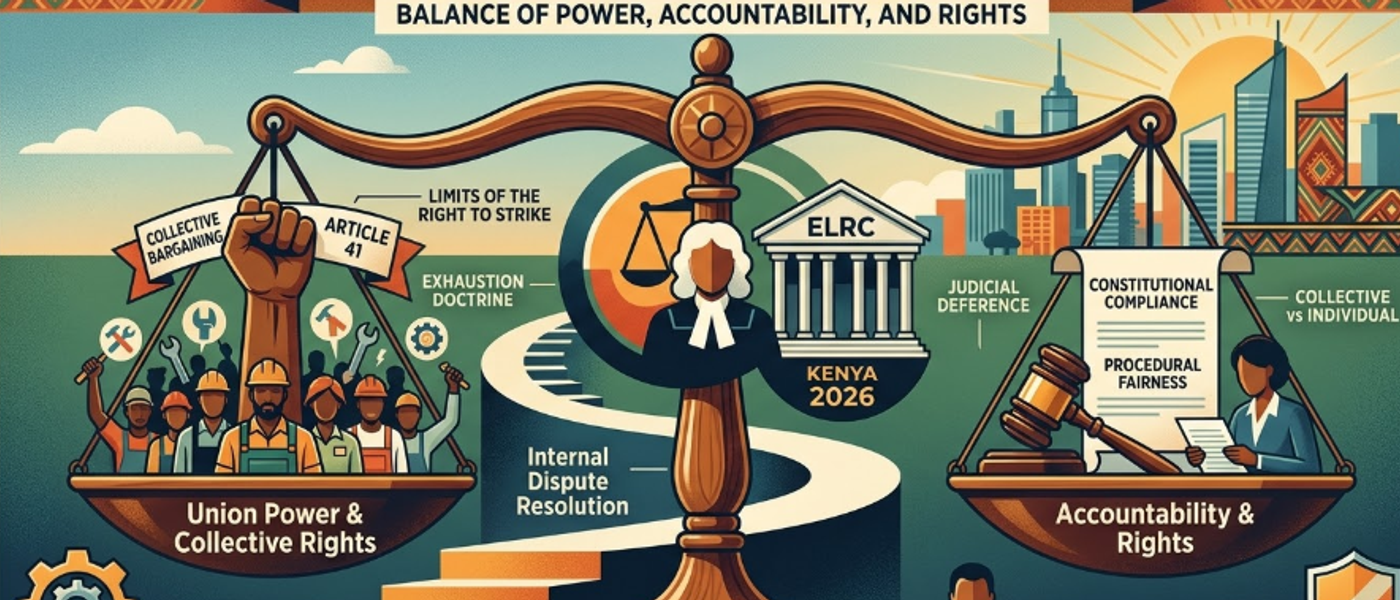
Four key themes emerge from recent case law: the limits of the right to strike, the mandatory nature of internal dispute resolution, judicial protection of union governance, and the growing tension between collective and individual rights.
The Right to Strike and Its Constitutional Limits
The right to strike is one of the most visible and powerful tools available to trade unions. It is expressly protected under Article 41 of the Constitution and regulated by the Labour Relations Act, 2007. However, recent ELRC decisions demonstrate that this right is subject to important limitations, particularly where it intersects with public interest.
In disputes involving essential services, the courts have consistently held that industrial action must not compromise public safety, health, or life. In County Government of Machakos v Kenya National Union of Medical Laboratory Officers (KNUMLO) (2026), the Court emphasized that workers in essential services are required to maintain minimum service levels during a strike. This position reflects the statutory restrictions under Section 81 of the Labour Relations Act, which limit the right to strike in sectors where interruption would endanger the public.
The jurisprudence thus establishes a clear boundary: while the right to strike is fundamental, it must be exercised responsibly and within the confines of the law. Where a strike threatens essential services, the courts will intervene to protect the broader public interest.
The Exhaustion Doctrine and the Primacy of Internal Mechanisms
A second defining feature of recent jurisprudence is the firm enforcement of the exhaustion doctrine. The ELRC has repeatedly emphasized that disputes arising within unions must first be addressed through internal mechanisms before being escalated to the courts.
In cases such as Evans & Another v Kenya Union of Post Primary Education Teachers (2026) and Deya & Others v Registrar of Trade Unions (2026), the Court declined to assume jurisdiction where parties had failed to utilize internal dispute resolution processes provided for in union constitutions and the Labour Relations Act.
This approach is grounded in both legal and policy considerations. It recognizes the autonomy of unions as self-governing institutions and promotes orderly resolution of disputes within established structures. Judicial intervention is therefore reserved for situations where internal mechanisms have been exhausted or are demonstrably ineffective.
The courts have made it clear that litigation is not a substitute for internal governance processes. Rather, it is a last resort.
Judicial Deference to Union Governance and Electoral Processes
Union elections and internal governance structures have also come under judicial scrutiny in recent years. However, the ELRC has adopted a cautious and restrained approach, demonstrating a clear reluctance to interfere in internal democratic processes unless there is compelling evidence of illegality or procedural unfairness.
In Deya & Others v Registrar of Trade Unions (2026), the Court reaffirmed that it will not lightly disrupt union elections. It emphasized that unions are democratic institutions whose internal processes should be respected, provided they comply with the law and constitutional standards.
This jurisprudence reflects a broader commitment to institutional integrity. Courts are mindful of the risk of being drawn into internal political disputes and have therefore set a high threshold for intervention. Only where there is clear violation of rights or statutory provisions will the court step in.
In effect, the judiciary is positioning itself not as a manager of union affairs, but as a guardian of legality and fairness.
The Tension Between Collective and Individual Rights
Perhaps the most nuanced development in recent union jurisprudence is the growing tension between collective rights and individual member rights. While unions operate on the principle of collective representation, individual members are increasingly invoking constitutional protections to challenge internal decisions.
Disputes relating to membership classification, voting rights, and eligibility to participate in union activities have become more prominent. In Kenya County Government Workers Union v Registrar of Trade Unions (2026), the Court was called upon to examine issues surrounding membership categorization and its implications for participation in union governance.
These cases highlight the challenge of balancing two competing imperatives. On the one hand, unions must maintain cohesion and function effectively as collective bodies. On the other hand, individual members are entitled to fair administrative action and freedom of association under Articles 47 and 36 of the Constitution.
The courts are increasingly navigating this tension by ensuring that union decisions are not arbitrary, discriminatory, or procedurally unfair, while still preserving the collective nature of union operations.
Conclusion
The evolving jurisprudence of the ELRC in 2026 reflects a maturing legal framework for union governance in Kenya. The courts are no longer passive observers but active participants in shaping the boundaries within which unions operate.
Several key principles can be distilled from recent decisions. The right to strike, while fundamental, is subject to limitations where public interest is at stake. Internal dispute resolution mechanisms must be respected and exhausted before recourse to the courts. Union governance, particularly electoral processes, is afforded a high degree of judicial deference, with intervention reserved for clear cases of illegality. Finally, the relationship between collective and individual rights is becoming increasingly complex, requiring careful judicial balancing.
Taken together, these developments underscore a broader shift towards accountability, structure, and constitutional compliance in union governance. Trade unions remain powerful institutions, but that power is now firmly anchored within a legal framework that demands responsibility and fairness.
In this emerging landscape, the guiding principle is clear: union governance must not only be democratic, it must also be lawful, transparent, and just.