The Doctrine of Pleasure in Kenyan Public Employment Law: From Absolute Power to Constitutional Accountability
For many years in public service law, government employment was governed by a powerful and controversial principle known as the Doctrine of Pleasure. Under this doctrine, a public officer served “at the pleasure” of the appointing authority, meaning the employer,traditionally the sovereign or executive authority, could terminate the employment relationship at any time, without assigning reasons and without affording the employee an opportunity to be heard. In its classical formulation, the doctrine reflected the hierarchical nature of early public administration systems, where executive power was largely unchecked and employment protections were minimal.
However, in modern constitutional democracies, including Kenya, the doctrine has undergone significant transformation. The evolution of labour law, the emergence of constitutional rights, and the growing emphasis on accountability in public administration have steadily eroded the absolute nature of the doctrine. Courts have played a crucial role in redefining the doctrine to align it with the values of fairness, legality, and respect for human rights embedded in the Constitution of Kenya, 2010. Today, the doctrine survives only in a limited and qualified form, subject to the strict requirements of constitutionalism and statutory labour protections.
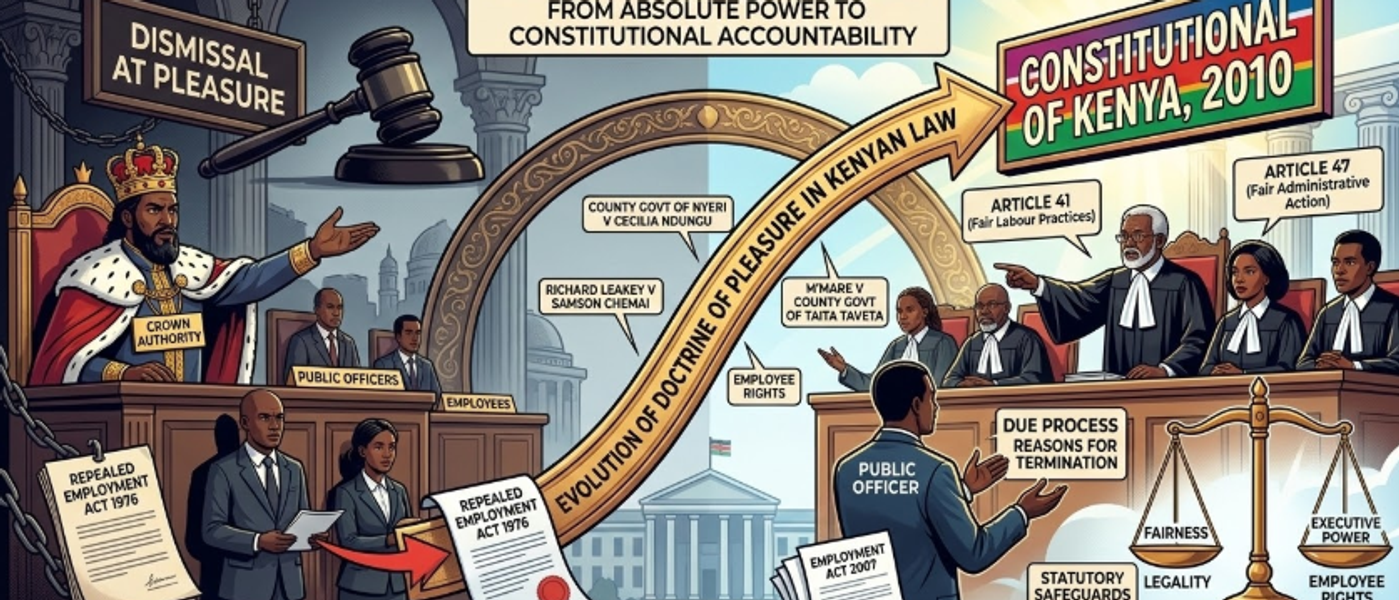
Historically, the doctrine of pleasure originated in English constitutional law. Public officers were considered servants of the Crown and held office at the pleasure of the monarch. This meant that the Crown could remove them from office without providing notice, reasons, or a hearing. The doctrine was transplanted into many Commonwealth jurisdictions, including Kenya during the colonial period. Under the repealed Employment Act of 1976, the employment relationship often reflected this hierarchical model in which employers wielded wide discretion to terminate employment, especially in the public sector.
The legal landscape changed dramatically with the enactment of the Employment Act, 2007, and the promulgation of the Constitution of Kenya, 2010. These instruments fundamentally altered employment relations by introducing clear statutory and constitutional safeguards against arbitrary dismissal. The Employment Act now requires employers to provide valid and fair reasons for termination, to follow due process, and to give employees an opportunity to respond to allegations before disciplinary action is taken. Equally significant are the constitutional guarantees under Article 41, which protects the right to fair labour practices, and Article 47, which guarantees the right to fair administrative action. These provisions collectively establish a legal framework that prioritizes fairness and procedural justice in employment decisions.
The Courts have repeatedly affirmed that the doctrine of pleasure cannot be invoked to circumvent these protections. One of the most important decisions in this regard is the Court of Appeal case of County Government of Nyeri & another v Cecilia Wangechi Ndungu (2015). In that case, the Court was called upon to determine whether a governor had an unfettered power to dismiss a County Executive Committee member at pleasure. While acknowledging that the County Governments Act appeared to grant the governor authority to dismiss such officials, the Court emphasized that this power could not be exercised arbitrarily. The judges observed that the doctrine of pleasure had evolved significantly over time and must now be interpreted in a manner consistent with democratic governance. The Court held that although the governor possessed the power to dismiss, that power had to be exercised reasonably and in accordance with constitutional principles. In other words, the doctrine was no longer absolute but subject to limitations imposed by the rule of law.
A similar approach was adopted by the Court of Appeal in Richard Erskine Leakey & 2 others v Samson Kipkoech Chemai (2019). In that case, the Court examined the historical origins of the doctrine and emphasized that its application had been progressively constrained by constitutional and legal developments. The Court noted that modern jurisprudence requires that public power be exercised rationally and for legitimate purposes. Even where the doctrine of pleasure appears to grant broad discretion, that discretion must not be exercised whimsically, capriciously, or in a manner that undermines constitutional rights. The decision reaffirmed that public authorities must remain accountable to the principles of fairness, legality, and reasonableness when making employment decisions.
More recently, the Employment and Labour Relations Court revisited the doctrine in M’Mare & another v County Government of Taita Taveta (2026). In that case, two advisors employed by the county government had their contracts abruptly terminated by the governor. The county government argued that the advisors served at the governor’s pleasure and that their contracts allowed termination by notice. The Court rejected this argument, emphasizing that the doctrine of pleasure could not override the statutory protections provided under the Employment Act. The judge observed that the doctrine belonged largely to the era of the repealed employment legislation and had little place in the contemporary legal framework governing labour relations. The Court held that the termination was unlawful because the employees had not been given reasons for their dismissal or an opportunity to be heard. As a result, the Court declared the termination unfair and awarded the claimants compensation equivalent to ten months’ salary.
These decisions illustrate the progressive transformation of the doctrine within Kenyan public employment law. While the doctrine has not been entirely abolished, its operation is now heavily restricted. Public employers, including national and county governments, cannot rely on the doctrine as a shield against accountability. Instead, they must comply with the procedural and substantive requirements of the Employment Act and the Constitution.
The modern legal position therefore reflects a delicate balance between executive authority and employee protection. Certain public offices may still involve elements of political discretion, particularly where appointments are closely linked to the confidence of elected leaders. Nevertheless, even in such circumstances, the exercise of power must conform to the standards of fairness and legality required by law. Arbitrary termination of employment is incompatible with the constitutional commitment to dignity, equality, and fair labour practices.
The transformation of the doctrine of pleasure is ultimately a reflection of Kenya’s broader constitutional journey. The country has moved away from a system characterized by centralized administrative power toward a framework grounded in the rule of law and respect for individual rights. Public officials, including governors and other executive authorities, are no longer free to exercise employment powers without restraint. Their decisions must now withstand scrutiny under both statutory labour law and constitutional principles.
In this sense, the doctrine of pleasure has been reshaped rather than completely discarded. It no longer represents absolute executive control over public employment but instead operates within a constitutional order that prioritizes fairness, accountability, and respect for human dignity. The Courts have made it clear that the doctrine cannot be used as a tool to justify arbitrary dismissals. Public power, like all other forms of authority in a constitutional democracy, must be exercised within the limits of the law.
The evolution of this doctrine therefore sends a powerful message about the nature of governance in modern Kenya. Public employment is no longer defined by the whims of those in power but by a legal framework designed to protect both the integrity of public institutions and the rights of those who serve within them. In the final analysis, the doctrine of pleasure has been transformed from a symbol of unchecked authority into a principle constrained by the Constitution, the rule of law, and the enduring demand for justice in the workplace.