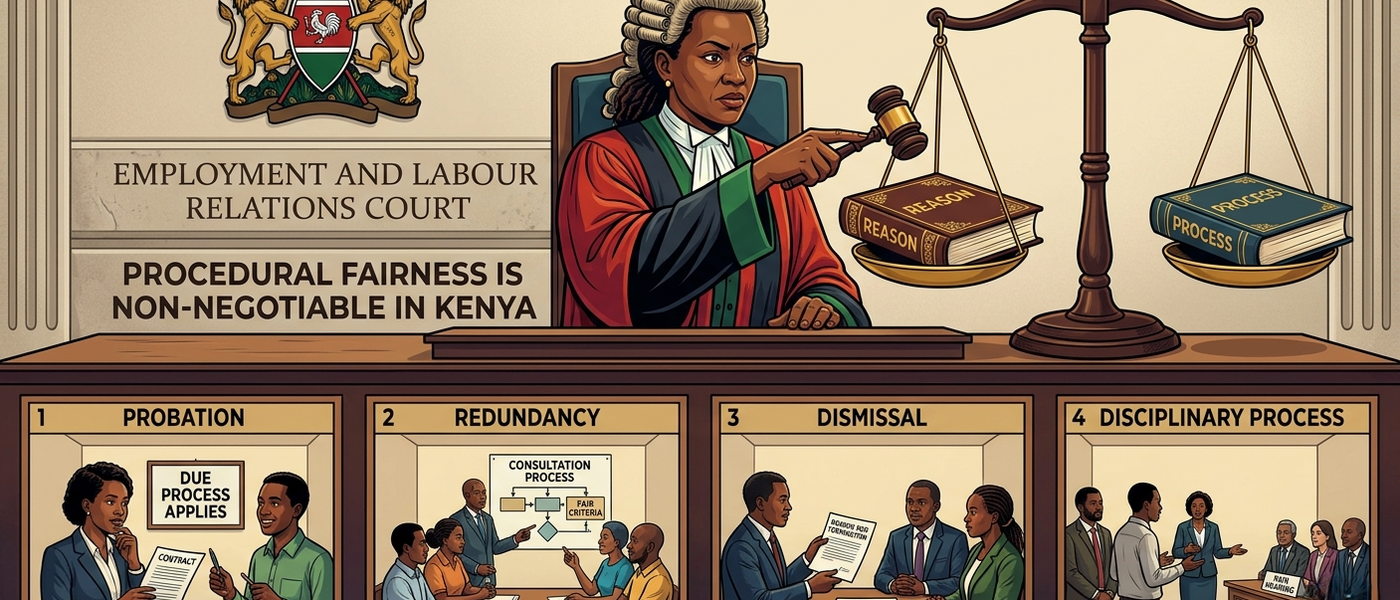
Procedural Fairness in Employment Law: Why It Is Now Non-Negotiable in Kenya
In recent years, and with increasing clarity in 2026,the Employment and Labour Relations Court (ELRC) has fundamentally reshaped the landscape of employment law in Kenya. A consistent and unmistakable judicial theme has emerged across a wide range of decisions: procedural fairness is no longer optional.
Courts are no longer concerned solely with whether an employer had a valid reason to terminate or discipline an employee. Instead, equal, if not greater, attention is now being paid to the process through which such decisions are reached. The modern judicial position can be summarised in a simple but powerful principle:
Process is as important as reason
This evolving jurisprudence is grounded in both statute and the Constitution. The Employment Act, 2007,particularly sections 41, 43, 45 and 40 , sets out the procedural and substantive requirements governing termination. These statutory protections are reinforced by constitutional guarantees under Articles 41 (fair labour practices), 47 (fair administrative action), and 50 (fair hearing). Together, they establish procedural fairness as a central pillar of lawful employment practice.
This article examines how the doctrine of procedural fairness now applies across four key areas of employment law: probation, redundancy, dismissal, and disciplinary processes.
1. Procedural Fairness During Probation
Traditionally, probationary employment was viewed as a period during which employers enjoyed broad discretion to terminate employment with minimal procedural obligations. This understanding was largely anchored in section 42(1) of the Employment Act, which appeared to exempt probationary contracts from the procedural safeguards under section 41.
However, recent jurisprudence has significantly altered this position. In Monica Munira Kibuchi & 6 others v Mount Kenya University (2021), the Court declared section 42(1) unconstitutional to the extent that it denied employees on probation the right to procedural fairness. This position was subsequently affirmed by the Court of Appeal in Red Lands Roses Ltd v Mugo (2025).
The ELRC applied this principle in Okumu v Simba Pharmaceutical Ltd (2026), where it held that termination during probation, particularly where it is based on operational reasons, must comply with the same procedural standards applicable to confirmed employees. The Court rejected the notion that probation permits summary or informal termination without due process.
The implication is clear: probation is no longer a procedural safe zone for employers. Even during probation, employers are required to notify the employee of the reasons for termination, accord them a hearing, and justify the decision both substantively and procedurally.
2. Redundancy: From Managerial Prerogative to Legal Process
Redundancy has emerged as one of the most strictly regulated areas of employment law. While employers retain the right to reorganise their businesses, the exercise of this right is now subject to rigorous procedural scrutiny under section 40 of the Employment Act.
The law requires employers to demonstrate both a valid operational reason for redundancy and strict adherence to procedural safeguards. These include issuing proper notices to the employee and the labour officer, engaging in consultation, applying fair selection criteria, and providing evidence to support the redundancy decision.
In Okumu v Simba Pharmaceutical Ltd (2026), the Court invalidated a redundancy process on the grounds that the employer had failed to issue proper notice, had not consulted the employee, and had not provided evidence to justify the alleged operational need. The Court emphasised that redundancy must meet both the substantive and procedural tests as articulated in Thomas De La Rue (K) Ltd v Omutelema (2013) and Kenya Airways Ltd v Aviation & Allied Workers Union (2014).
The jurisprudential shift is evident: redundancy is no longer merely a business decision, it is a legal process that must be strictly followed. Any deviation from the prescribed procedure renders the termination unlawful, regardless of the underlying business rationale.
3. Dismissal: The Dual Requirement of Reason and Process
Sections 43 and 45 of the Employment Act establish the legal framework for termination of employment. These provisions require employers to prove both the existence of a valid reason for termination and that the termination was carried out in accordance with fair procedure.
This dual requirement has been consistently reinforced by the courts. The seminal decision in Walter Ogal Anuro v Teachers Service Commission (2013) remains authoritative in establishing that a termination must satisfy both substantive justification and procedural fairness.
Recent ELRC decisions have applied this principle with increasing strictness. Employers who fail to conduct a proper hearing, issue adequate notice, or allow employees an opportunity to respond to allegations are routinely found to have acted unfairly, even where there may have been a valid reason for dismissal.
The courts have thus made it clear that a valid reason alone is insufficient. Without adherence to due process, termination will not withstand judicial scrutiny.
4. Disciplinary Processes: The Centrality of the Right to Be Heard
The disciplinary process is the primary mechanism through which employers enforce workplace standards. However, it is also an area where procedural missteps frequently occur.
Section 41 of the Employment Act sets out the minimum requirements for a fair disciplinary process. These include informing the employee of the charges against them, allowing them to respond, and permitting representation during the hearing.
In Birgen v Lipton Teas and Infusions Kenya PLC (2026), the Court upheld a dismissal for misconduct largely because the employer had complied with these procedural requirements. The employer issued a show cause letter, conducted a disciplinary hearing, and followed its internal procedures. This compliance with due process was central to the Court’s finding that the termination was fair.
Conversely, where employers fail to disclose evidence, rush disciplinary proceedings, or predetermine outcomes, the courts have not hesitated to invalidate the resulting decisions.
The emerging position is that the disciplinary process is not a mere formality, it is a legal safeguard that must be strictly observed.
5. The Constitutionalisation of Procedural Fairness
A notable development in recent jurisprudence is the constitutionalisation of procedural fairness in employment law. Courts are increasingly grounding their decisions not only in the Employment Act but also in constitutional principles.
Article 41 guarantees fair labour practices, Article 47 protects the right to fair administrative action, and Article 50 secures the right to a fair hearing. These provisions elevate procedural fairness from a statutory requirement to a constitutional imperative.
As a result, employment decisions are now subject to a higher standard of scrutiny, with courts examining whether employers have acted fairly, transparently, and reasonably in both substance and procedure.
Conclusion
The trajectory of ELRC jurisprudence in 2026 leaves little room for doubt: procedural fairness is now the cornerstone of lawful employment practice in Kenya.
Employers can no longer rely on contractual clauses, internal policies, or managerial discretion to justify decisions that are procedurally flawed. Whether dealing with probation, redundancy, dismissal, or disciplinary action, adherence to due process is essential.
The modern legal position is uncompromising. A procedurally defective decision will be struck down, regardless of its substantive justification.
In practical terms, this means that employers must invest in structured, transparent, and well-documented HR processes. Failure to do so carries significant legal risk.
Ultimately, the message from the courts is clear:
If you do not follow the process, you will not succeed in defending the decision.
Procedural fairness is no longer a technical requirement, it is the foundation upon which all employment decisions must stand.