Employee Rights in Kenya: The ELRC’s Expanding Protection of Workers in 2026
Recent jurisprudence from the Courts (ELRC) in 2026 reflects a decisive shift in the protection of employee rights in Kenya. Courts are increasingly adopting a pragmatic and rights-based approach to employment disputes, focusing not merely on formal documentation, but on the realities of the employment relationship, fairness of process, and evidentiary responsibility.
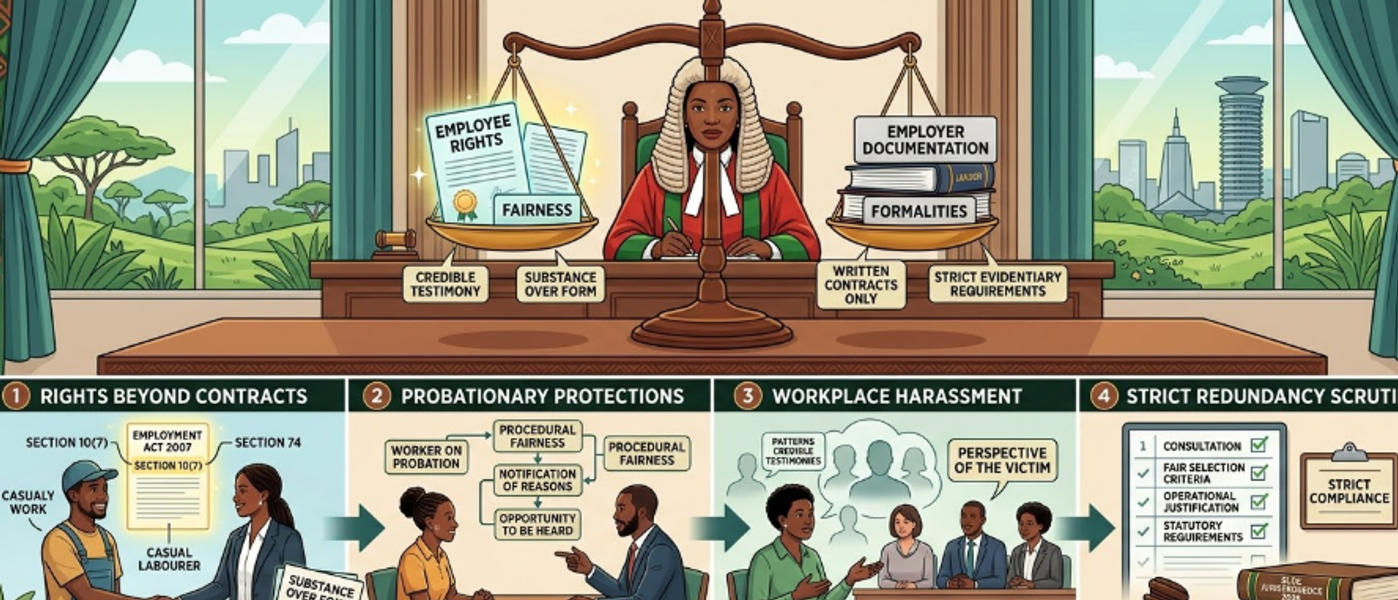
This evolving body of law reveals a powerful underlying principle: employees are far more protected than they often realise. Whether dealing with informal employment arrangements, probationary contracts, allegations of unfair termination, workplace harassment, or redundancy, the courts are consistently affirming that legal protection is not dependent on formality, but on fairness and compliance with the law.
The Recognition of Rights Beyond Written Contracts
One of the most important developments in recent ELRC decisions is the recognition that employment rights do not depend on the existence of a written contract. The Employment Act, 2007, particularly sections 9 and 10, requires employers to issue written contracts in certain circumstances. However, where an employer fails to comply with this obligation, the law does not penalise the employee.
Instead, section 10(7) of the Act shifts the burden to the employer to disprove the terms alleged by the employee. Section 74 further obligates employers to maintain employment records. These provisions have been interpreted by the courts to mean that the absence of documentation cannot be used as a shield by the employer.
This position was clearly demonstrated in Ajega v China Jiangsu International Co. Ltd (2026), where the Court accepted the testimony of a casual labourer and held that the employer’s failure to produce employment records justified an adverse inference. The Court affirmed that the existence of an employment relationship is determined by the substance of the engagement, not the presence of formal documentation.
Accordingly, employees engaged on informal or casual terms remain fully protected under the law.
The Lowering of Evidentiary Barriers in Unfair Termination Claims
Another notable development is the increasing willingness of courts to accept credible employee testimony in the absence of documentary evidence. Traditionally, employees faced significant challenges in proving unfair termination, particularly where they lacked access to employer records.
However, recent decisions demonstrate that this barrier is gradually being dismantled. Courts are now more inclined to rely on uncontroverted testimony, especially where the employer fails to rebut the employee’s claims or to produce relevant records within its control.
This approach is consistent with evidentiary principles under sections 107 to 112 of the Evidence Act, which place the burden of proof on the party best positioned to produce evidence. Where the employer fails to discharge this burden, courts are increasingly prepared to resolve doubts in favour of the employee.
The implication is that employees are no longer required to present perfect or exhaustive evidence. Credible and consistent testimony may suffice, particularly where the employer remains silent or fails to challenge the evidence.
The Extension of Procedural Protections to Probationary Employees
The position of probationary employees has also undergone significant transformation. Historically, probation was treated as a period during which employers could terminate employment with minimal procedural obligations, relying on section 42(1) of the Employment Act.
This position has since been overturned. In Monica Munira Kibuchi & 6 others v Mount Kenya University (2021), the Court declared section 42(1) unconstitutional to the extent that it excluded probationary employees from procedural safeguards. This decision was affirmed by the Court of Appeal in Red Lands Roses Ltd v Mugo (2025).
The Court applied this principle in Okumu v Simba Pharmaceutical Ltd (2026), holding that an employee on probation is entitled to procedural fairness. The Court emphasized that termination during probation must comply with the requirements of section 41 of the Employment Act, including notification of the reasons for termination and an opportunity to be heard.
This development underscores the fact that probation does not diminish an employee’s right to fair treatment.
The Evolving Approach to Workplace Harassment
Workplace harassment claims have historically been difficult to prove, often due to the absence of direct evidence or independent witnesses. However, recent ELRC decisions indicate a shift towards a more nuanced and victim-centred approach.
In Birgen v Lipton Teas and Infusions Kenya PLC (2026), the Court acknowledged that harassment may be established through patterns of conduct, surrounding circumstances, and credible testimony. The Court relied on persuasive authorities such as Ooko & Another v SRM & Others (2022) and Leonard Maternity & Nursing Home v LMM (2023), which emphasize that harassment should be assessed from the perspective of the victim.
This approach recognises the inherent difficulties in proving harassment and reduces the evidentiary burden on employees. It reflects a broader commitment by the courts to ensure that such claims are assessed fairly and contextually, rather than dismissed for lack of direct proof.
The Strict Scrutiny of Redundancy Processes
Redundancy remains one of the most contentious areas of employment law, and recent decisions demonstrate that courts are subjecting such processes to rigorous scrutiny.
Section 40 of the Employment Act sets out detailed procedural requirements for redundancy, including notice to the employee and labour officer, consultation, fair selection criteria, and justification based on operational needs. These requirements are mandatory and must be strictly complied with.
In Okumu v Simba Pharmaceutical Ltd (2026), the Court invalidated a redundancy process due to multiple procedural defects, including inadequate notice, lack of consultation, and absence of evidence to support the alleged operational necessity. The Court relied on established authorities such as Thomas De La Rue (K) Ltd v Omutelema (2013) and Kenya Airways Ltd v Aviation & Allied Workers Union (2014), which affirm that redundancy must meet both substantive and procedural fairness.
This line of jurisprudence demonstrates that redundancy is not immune from challenge. Where employers fail to comply with the law, employees are entitled to seek redress.
Conclusion
The jurisprudence emerging from the Courts in 2026 reflects a clear and progressive shift towards enhanced employee protection. The courts are increasingly prioritising fairness, accountability, and evidentiary responsibility over formalistic considerations.
Across various contexts, the principles are consistent:
- the absence of a written contract does not negate employment rights;
- credible testimony can suffice where documentary evidence is lacking;
- probationary employees are entitled to full procedural protection;
- workplace harassment can be established without direct evidence;
- redundancy must strictly comply with statutory requirements.
These developments signal a broader transformation in employment law, one that recognises the realities of the workplace and seeks to protect employees from procedural and substantive injustice.
Ultimately, the message is both clear and empowering:
Employment rights do not depend on formality, they depend on fairness.
For employees, understanding this evolving legal landscape is essential. It is through this understanding that rights can be asserted, protected, and enforced.