The Death of Informal HR in Kenya: Why Documentation Is Now a Legal Imperative
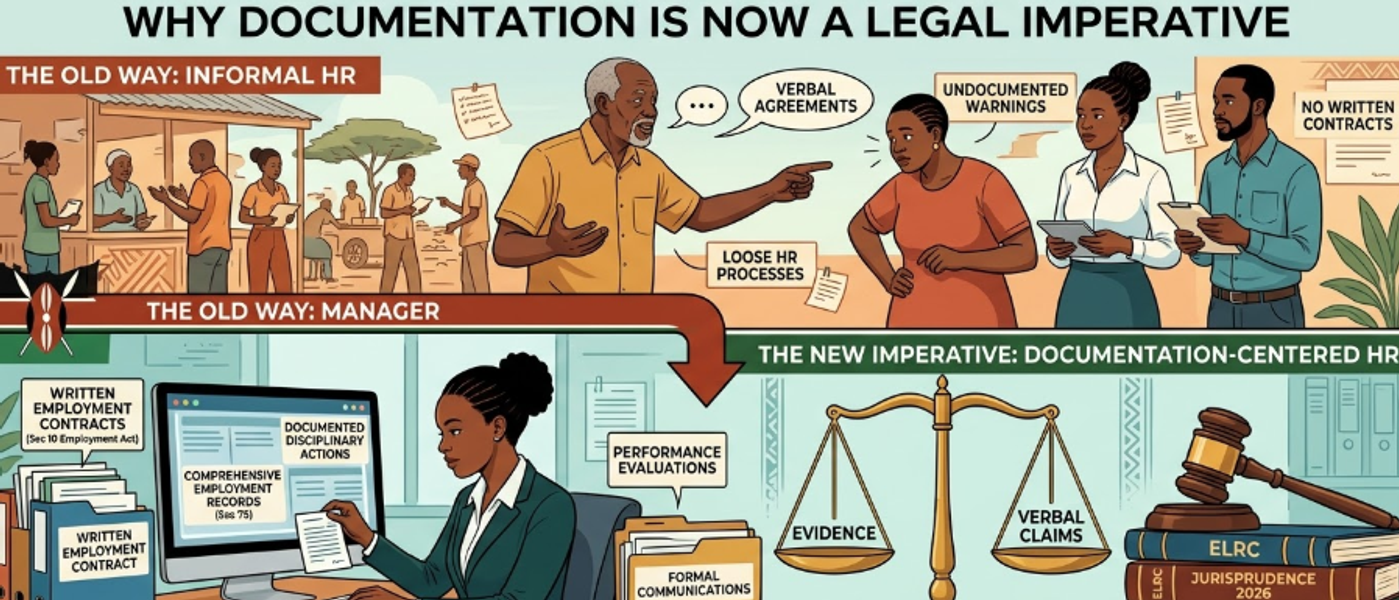
For many years, a significant number of employers in Kenya, particularly in fast-paced or informal sectors, have managed employment relationships through unwritten practices. Verbal agreements, undocumented disciplinary actions, and loosely structured HR processes have been commonplace. These practices were often driven by convenience, cost-saving, or a belief that formality was unnecessary in day-to-day operations.
However, recent jurisprudence from the Employment and Labour Relations Court (ELRC), particularly in 2026, signals a decisive shift. The courts are increasingly dismantling informal human resource practices and replacing them with a strict, evidence-driven approach grounded in statute and constitutional principles.
The emerging judicial position is clear and uncompromising:
If it is not documented, it does not exist in law.
Employers who fail to maintain proper records, formalize employment relationships, and document decisions are now facing significant legal consequences, often losing cases irrespective of the substantive merits of their position.
The Statutory Duty to Formalize Employment
The foundation of this shift lies in the Employment Act, 2007, which imposes clear obligations on employers regarding documentation.
Section 9 and Section 10 require employers to issue written contracts for employees engaged for periods exceeding three months. More importantly, Section 10(7) provides that where an employer fails to produce a written contract, the burden shifts to the employer to disprove the terms alleged by the employee. Section 74 further mandates employers to keep comprehensive employment records, including details of wages, working hours, and other key terms.
These provisions are not merely administrative guidelines. They form the backbone of evidentiary requirements in employment disputes. In effect, they determine how courts allocate the burden of proof and ultimately decide cases.
Absence of Contracts and the Burden of Proof
One of the most significant developments in recent case law is how courts treat situations where there is no written contract.
In Ajega v China Jiangsu International Co. Ltd (2026), the Court dealt with a claim by a casual labourer whose employment had not been formalized in writing. The employer denied the existence of an employment relationship, relying on the absence of documentary evidence.
The Court rejected this argument. It held that the employer, being under a statutory duty to keep employment records, could not benefit from its own failure to comply with the law. In the absence of records, the Court accepted the employee’s testimony and drew an adverse inference against the employer.
This approach reflects a broader principle: where employers fail to document employment relationships, courts will reconstruct those relationships based on available evidence—often in favour of the employee.
The Consequences of Poor Record-Keeping
The failure to maintain proper employment records has become one of the most decisive factors in employment litigation. Courts are increasingly applying principles under the Evidence Act, particularly the rule that where a party has control of evidence and fails to produce it, the court may presume that such evidence would be adverse to that party.
This principle has been consistently applied in recent ELRC decisions. Employers who fail to produce documents such as attendance registers, payroll records, disciplinary notes, or performance evaluations find their cases significantly weakened.
In such circumstances, employee testimony, if credible and unchallenged, is often sufficient to establish liability. The absence of records does not create neutrality; it actively works against the employer.
The Legal Futility of Verbal HR Practices
Another recurring issue in recent cases is the reliance on verbal processes. Employers frequently assert that:
- employees were verbally warned;
- meetings were held;
- offers such as redeployment were made;
- performance concerns were communicated.
However, without written evidence, courts are increasingly unwilling to accept such assertions.
In Okumu v Simba Pharmaceutical Ltd (2026), the employer attempted to justify termination on the basis of operational changes, alleged performance issues, and an alleged offer of redeployment. The Court rejected these arguments because there was no documentary evidence to support them. There were no meeting minutes, no written communications, and no performance records.
The Court went further to note inconsistencies between the employer’s oral claims and its written communication, ultimately concluding that the termination was unlawful.
This reflects a firm judicial stance: verbal processes, no matter how genuine, carry little or no evidentiary weight unless supported by documentation.
The Collapse of Substantive Defences
Perhaps the most far-reaching consequence of informal HR practices is their impact on substantive legal defences. Even where an employer may have a valid reason for its decision, the absence of documentation often renders that reason indefensible in court.
For example:
- A redundancy will fail if there is no documented consultation, notice, or evidence of operational necessity.
- A performance-based termination will fail if there are no agreed targets, evaluations, or performance improvement plans.
- A misconduct dismissal will fail if there is no documented disciplinary process.
The Court of Appeal in National Bank of Kenya v Mutonya (2019) underscored that poor performance must be supported by measurable targets, documented evaluations, and evidence of failure to meet those targets. This principle has been repeatedly applied in subsequent ELRC decisions.
In essence, the courts are making it clear that a valid reason must be supported by verifiable evidence. Without documentation, even the most legitimate reasons are likely to fail.
The Reality: Losing Cases Due to Informality
A striking feature of recent ELRC decisions is that employers are increasingly losing cases not because their decisions were inherently wrong, but because they cannot prove them.
Across multiple cases:
- employers have advanced reasonable explanations;
- business decisions have appeared justifiable;
- employee misconduct or underperformance may have existed.
Yet, in the absence of documentation, courts have ruled against employers. This underscores a fundamental truth in employment litigation:
The outcome of a case is determined not by what happened, but by what can be proven.
The Shift Toward Documentation-Centered Employment Law
The ELRC is steadily developing a jurisprudence that places documentation at the centre of employment relationships. This emerging doctrine is characterized by several key principles:
- Employers bear the primary responsibility for maintaining employment records.
- Failure to produce such records shifts the evidentiary burden against the employer.
- Courts will rely on employee testimony where it is uncontroverted.
- Informal practices are insufficient to meet statutory and evidentiary thresholds.
This represents a fundamental transformation in employment law—from a system that tolerated informality to one that demands structure, transparency, and accountability.
Practical Implications for Employers
In light of this evolving jurisprudence, employers must take deliberate steps to formalize their HR practices. At a minimum, this includes:
- issuing written contracts to all employees;
- maintaining accurate and comprehensive employment records;
- documenting all disciplinary processes and decisions;
- ensuring all HR communications are recorded in writing;
- implementing clear, consistent, and acknowledged HR policies.
These measures are no longer optional best practices—they are essential safeguards against legal risk.
Conclusion
The message from the ELRC is unequivocal: the era of informal HR is over.
Employers who continue to rely on verbal agreements, undocumented decisions, and incomplete records expose themselves to significant liability. In today’s legal environment, employment relationships must be structured, documented, and capable of withstanding judicial scrutiny.
Ultimately, the governing principle is simple:
If you cannot prove it, you did not do it.
Documentation is no longer an administrative function…..it is the foundation of legal compliance in employment law.