A Practical Compliance Guide to the Data Protection Act in Kenya
Over the last few years, data protection has moved from being an abstract legal concept to a daily operational reality for organisations in Kenya. The enactment of the Data Protection Act, 2019 established a comprehensive framework governing how personal data should be collected, processed, stored, and disclosed. At the same time, the Office of the Data Protection Commissioner has begun actively enforcing the law through investigations, enforcement notices, and compensation awards.
Recent regulatory determinations and High Court decisions show that many organisations are still struggling to align their practices with the requirements of the Act. In many cases, the violations arise not from deliberate misconduct but from everyday operational practices that fail to appreciate the legal implications of handling personal data.
This article offers a practical compliance guide for organisations operating in Kenya. Drawing from emerging jurisprudence and enforcement trends, it highlights the key obligations imposed by the law and the steps organisations should take to remain compliant.
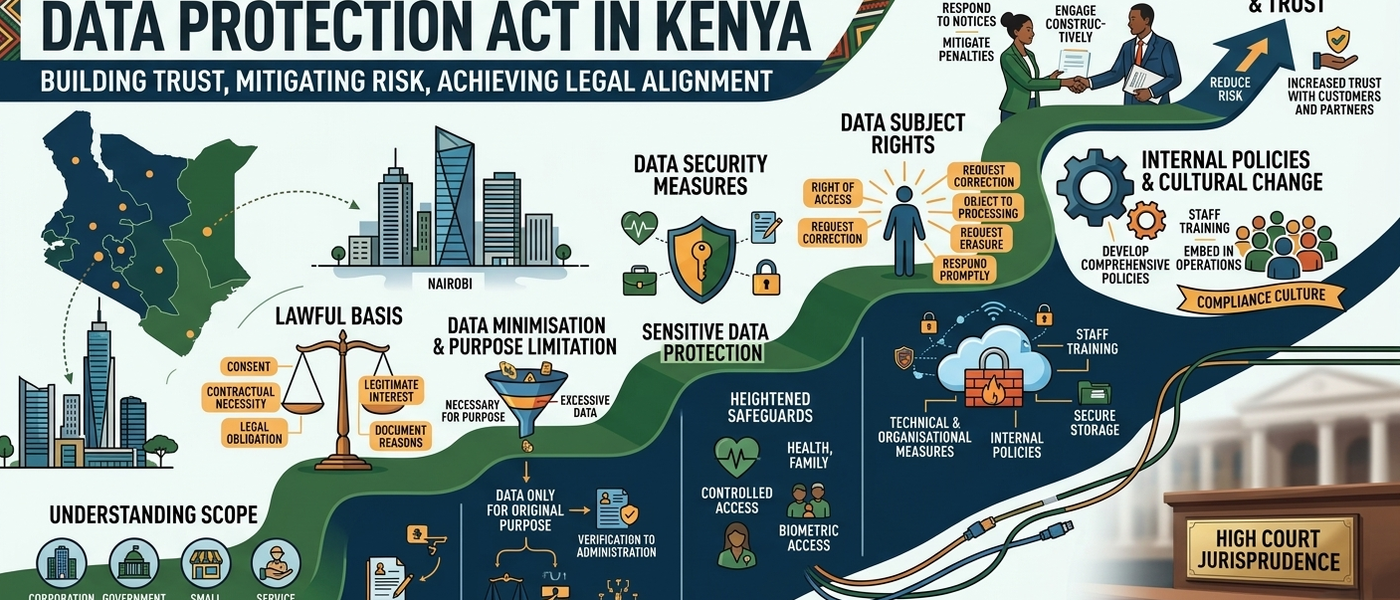
Understanding the Scope of the Law
The starting point for compliance is understanding that the Data Protection Act applies broadly to any person or entity that processes personal data. This includes corporations, government agencies, small businesses, service providers, and even individuals who determine the purpose and means of processing personal information.
Under the Act, two principal actors are recognized: data controllers and data processors. A data controller determines why and how personal data will be processed, while a data processor handles personal data on behalf of a controller. Both categories carry legal responsibilities, and organisations often occupy both roles simultaneously in different contexts.
Compliance therefore begins with identifying whether an organisation acts as a controller, a processor, or both.
Establishing a Lawful Basis for Processing
One of the most important requirements of the Act is that personal data must only be processed where there is a valid legal basis. In practice, this means that organisations must be able to justify every instance in which personal information is collected or used.
The most common lawful bases include consent, contractual necessity, legal obligation, and legitimate interest. Consent must be informed and voluntary, and individuals must understand how their data will be used.
Organisations frequently encounter difficulties when they cannot clearly explain why they collected certain personal data. In such cases, the processing may be deemed unlawful regardless of whether any harm was intended.
A well-designed compliance framework therefore requires organisations to clearly document the legal basis for every data processing activity.
Limiting Data Collection to What Is Necessary
The principle of data minimisation requires that organisations collect only the information that is strictly necessary for the specific purpose of the processing activity.
Many organisations still collect excessive personal information simply because it might be useful in the future. This practice is inconsistent with the law. Each category of personal data collected must serve a clearly defined purpose, and that purpose must be communicated to the data subject.
Adopting a minimalist approach to data collection not only enhances compliance but also reduces the risk of breaches and misuse.
Respecting the Purpose Limitation Principle
Closely linked to data minimisation is the principle of purpose limitation. Personal data collected for one purpose must not later be used for a different and incompatible purpose.
For example, documents submitted for verification, printing, or administrative processing cannot later be reused for marketing, publicity, or other unrelated purposes unless a new lawful basis is established.
Organisations should therefore ensure that personal data is used strictly within the boundaries of the purpose for which it was originally collected.
Protecting Sensitive Personal Data
Certain categories of personal information receive special protection under the Act. These include data relating to health, religious beliefs, family circumstances, biometric identifiers, and other highly personal matters.
Handling such data requires heightened safeguards. Organisations must ensure that access is strictly controlled and that appropriate security measures are in place to prevent unauthorized disclosure.
Failure to properly protect sensitive personal data can lead to significant regulatory consequences.
Implementing Strong Data Security Measures
The Act requires organisations to implement both technical and organisational measures to safeguard personal data. These measures should be proportionate to the nature of the data being processed and the risks involved.
Examples of appropriate safeguards include restricted access to databases, secure storage systems, staff training, and clear internal policies governing how personal data is handled.
Many data protection breaches occur because organisations rely on informal practices rather than structured security protocols. Establishing formal procedures for data management is therefore essential.
Responding to Data Subject Rights
One of the defining features of modern data protection law is the recognition of data subject rights. Individuals have the right to access their personal data, request corrections, object to processing, and in certain circumstances request deletion.
Organisations must establish procedures for responding to such requests promptly and transparently. Failure to respond adequately may expose an organisation to regulatory action.
Compliance therefore requires not only protecting personal data but also respecting the rights of the individuals to whom that data relates.
Developing Internal Data Protection Policies
Effective compliance cannot be achieved through ad hoc practices. Organisations should develop comprehensive internal policies that govern how personal data is handled across the entire organisation.
These policies should address issues such as data collection, storage, access controls, retention periods, and breach response procedures. Staff members should receive training to ensure that they understand their responsibilities when handling personal data.
A structured internal framework helps ensure that compliance becomes part of the organisation’s operational culture rather than an afterthought.
Cooperating with Regulatory Investigations
Where complaints arise, the regulator has the authority to investigate alleged violations of the law. Organisations should approach such investigations with transparency and cooperation.
Engaging constructively with the regulatory process not only demonstrates good faith but may also mitigate potential penalties.
Ignoring regulatory notices or failing to respond to investigations can significantly worsen an organisation’s legal position.
The Growing Importance of Data Protection Compliance
The enforcement landscape in Kenya is evolving rapidly. Regulatory determinations and court decisions are gradually clarifying how the law should be applied in practice. As awareness grows, individuals are increasingly willing to assert their rights and seek remedies for privacy violations.
For organisations, this development represents both a challenge and an opportunity. Compliance with the Data Protection Act is no longer optional; it is an integral part of responsible governance and risk management.
Businesses that adopt proactive compliance strategies will not only avoid regulatory sanctions but will also strengthen trust with their clients and partners.
In an increasingly data driven economy, respect for personal privacy is becoming a defining characteristic of responsible organisations.